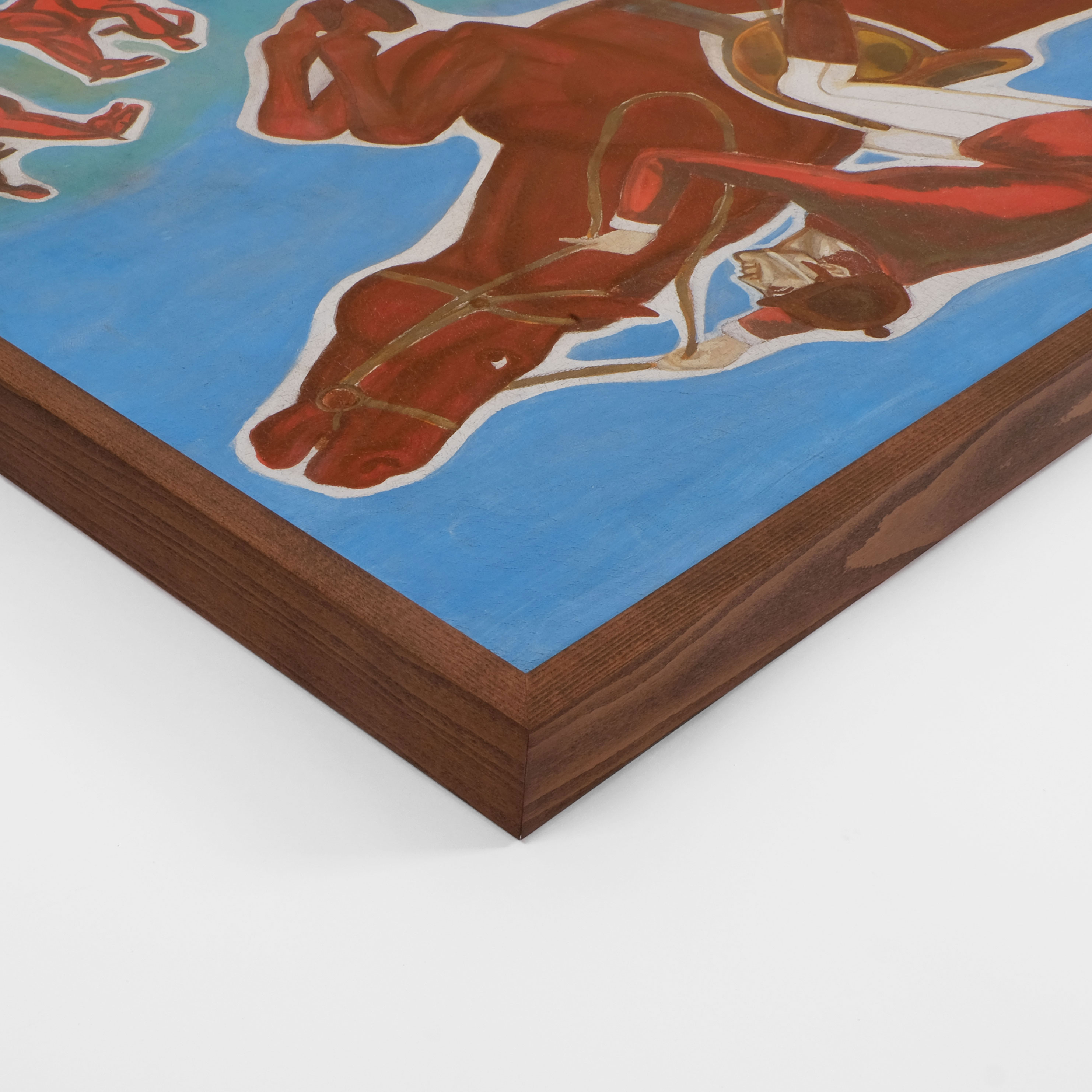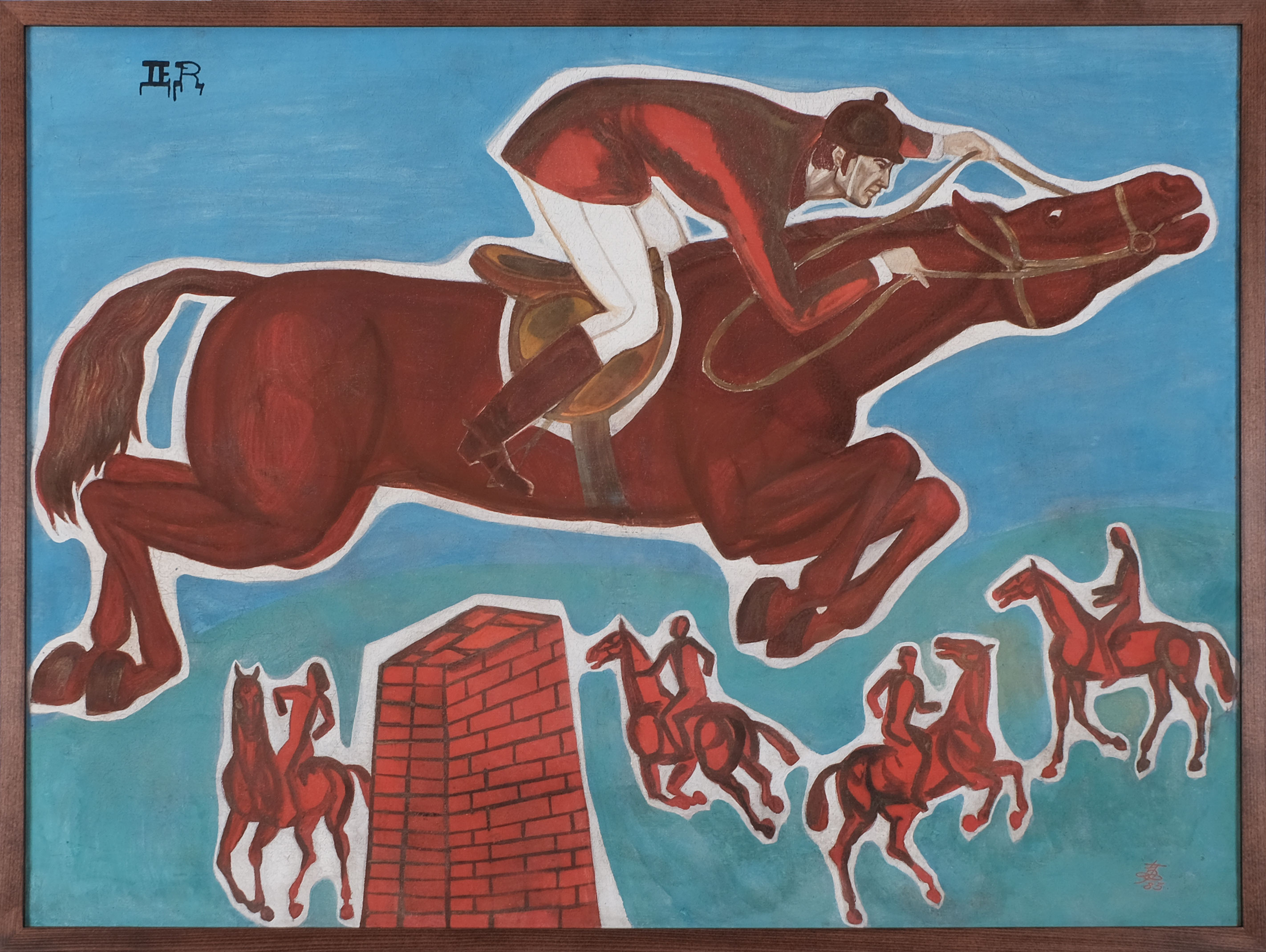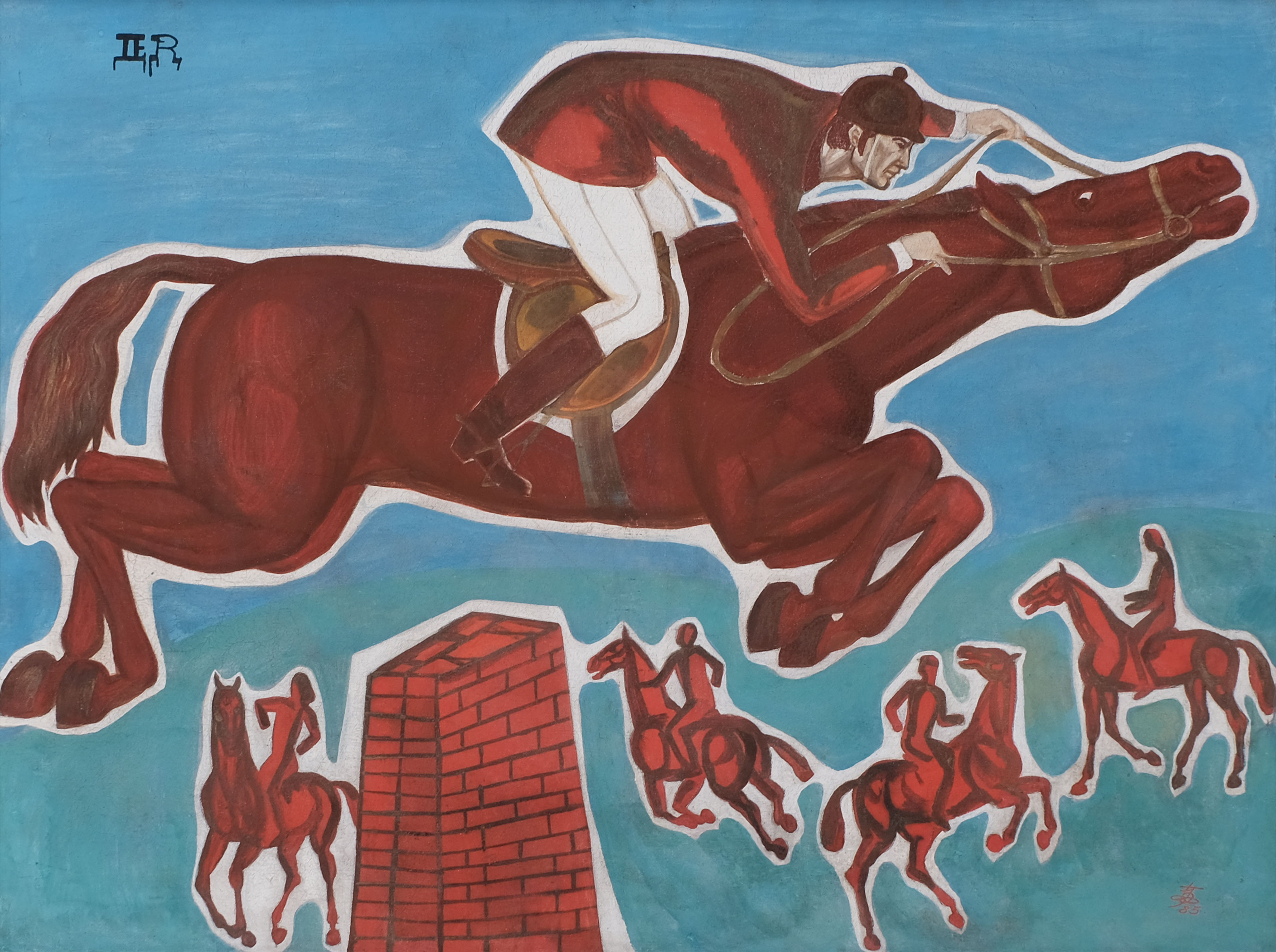
"Equestrian" (1983) by Felix Innokentievich Belsky captures the speed and power of steeplechase through stripped-down, expressionist design. A massive horse and rider dominate the canvas mid-leap, their bodies stretched and abstracted to prioritize force over realism.
The pair fills the upper two-thirds of the frame. Their forward thrust pulls the viewer into the action. A brick-red obstacle anchors the bottom edge and launches the motion upward, reinforcing the tension and drive of the jump.
Belsky reduces form to rhythm and shape. The scene recalls Matisse’s Dance (1910)—not in subject, but in energy and colour. Below the main figure, smaller horses and riders repeat in loose formation. The smaller horses act like echoes. The effect is musical: motion becomes pattern.
There’s a clear debt to the Russian avant-garde. Flat color fields, geometric forms, and stark outlines evoke Malevich and Suprematism. The burgundy horse with a white outline slices through the electric blue sky. The contrast heightens the illusion of motion, as if it is tearing through space.
This kind of visual economy—expressing motion and weight with minimal form—reflects Belsky’s training under Evgeny Kibrik at the Moscow State Academic Art Institute. Kibrik’s influence is visible in the clarity and compression of the scene.
Felix Innokentievich Belsky (1929–2009) graduated from the Moscow Institute in 1968 and was a longtime member of the Union of Artists of the USSR. He participated in nearly 80 exhibitions across Eastern Europe, Mongolia, and India. In 1991, he held a solo show in the U.S., and in 2007, he was inducted into the Russian Academy of Arts.