1
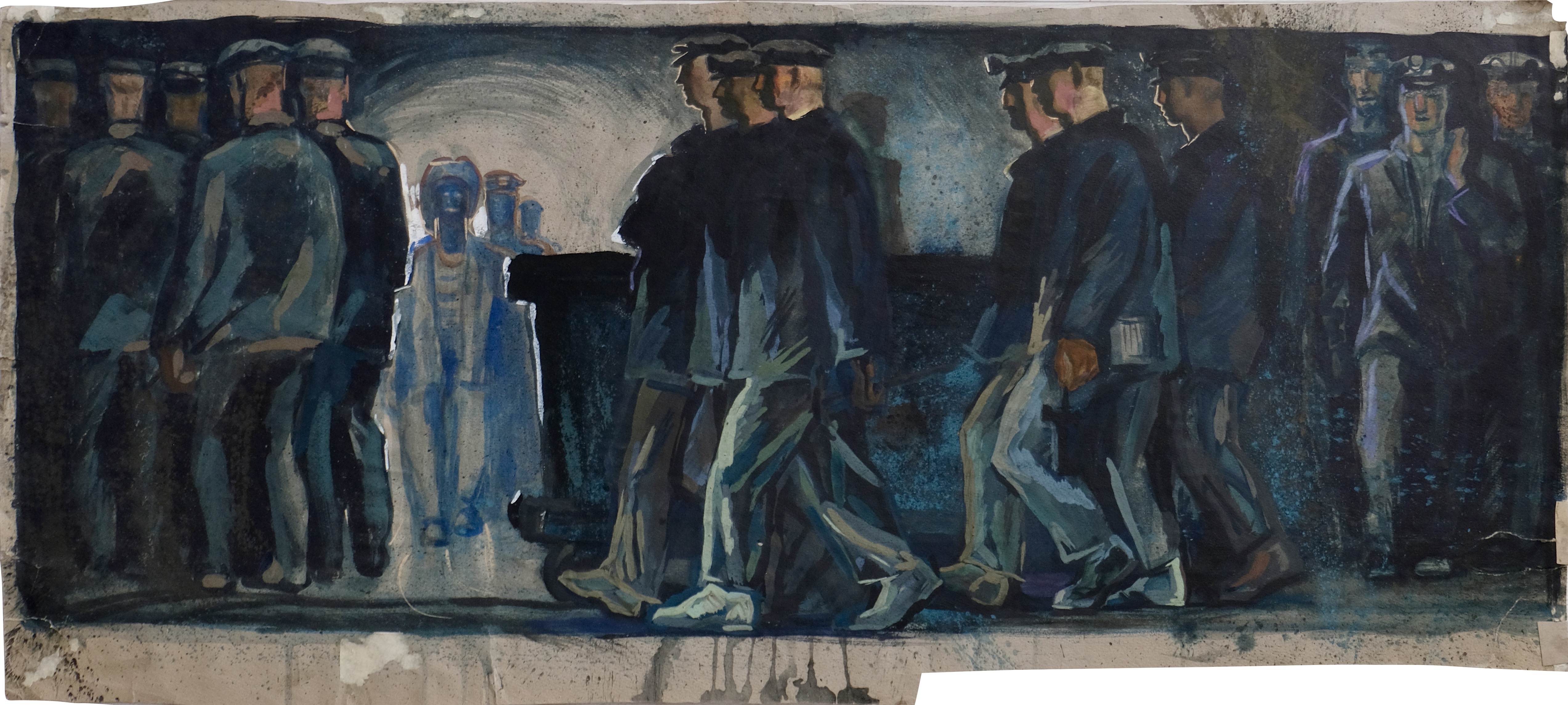
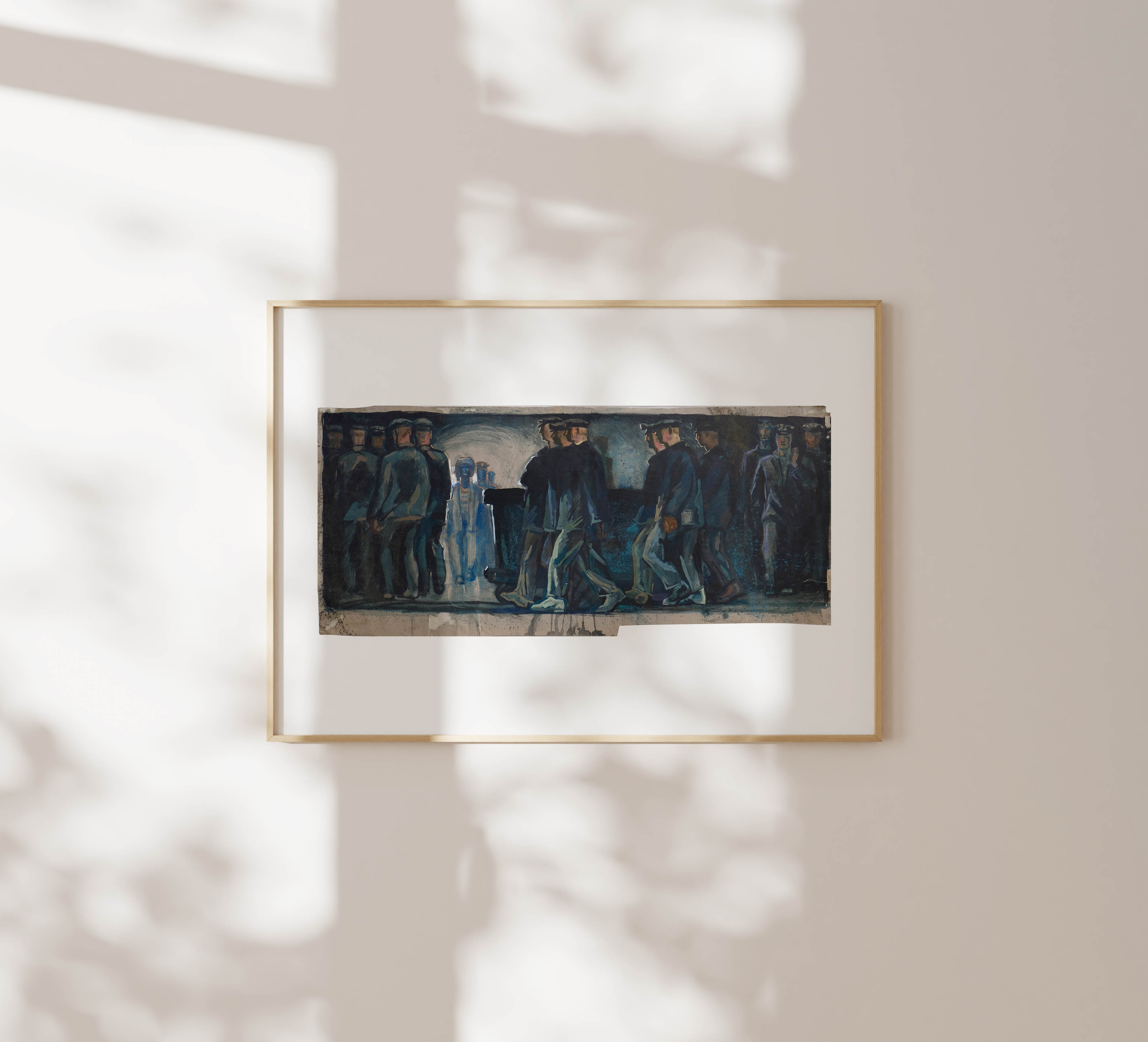
"At the Mine" (1960s) by Leonid Kurzenkov shows a shift change at a mine: one group of miners arriving for work, another emerging from underground, arranged in a frieze-like line across the composition.
The illuminated mine entrance sits at the centre, and the two groups are deliberately distinct. The arriving miners stand upright, ready. Those coming off shift are heavier in posture, worn down. The contrast is the whole point of the piece — same work, same place, two completely different physical states.
Kurzenkov trained in cinematography, and it shows in the lighting. The miners about to start their shift are lit in a cold blue-white that gives them a kind of clarity. The departing miners fade into shadow and muted tone, almost dissolving into the background. Light is doing the emotional work here, not gesture or expression.
What the piece captures, without spelling it out, is the cyclical grind of industrial labour — shift after shift, the same scene repeating, never resolving.
Kurzenkov (1936–2015) graduated from VGIK, the All-Union State Institute of Cinematography, in 1961, and began his career as a production artist at Lenfilm. He became a member of the Union of Artists of the USSR in 1964. Later in life he lost his sight but continued working across graphics, painting, and religious art. He received the Order of Saint Innocent of Moscow in 2007. His work is held in the State Historical Museum and the Museum of Traditional Art of the Peoples of the World in Moscow.