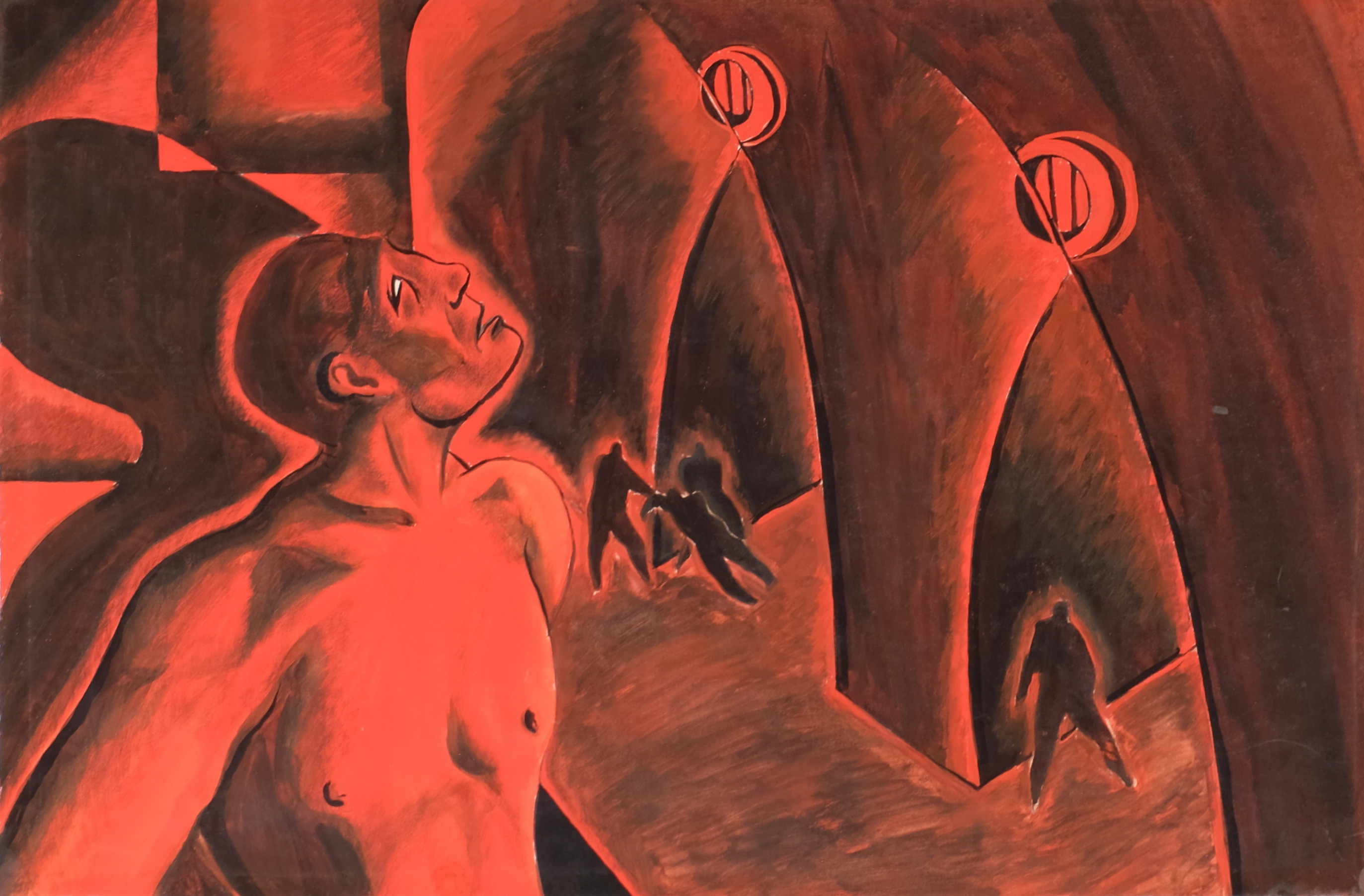
"Hard to be a God" (1970s) by Dmitry Fedorovich Bogorodsky is a stage design created for a theatrical adaptation of the Strugatsky brothers' 1964 science fiction novel of the same name. It shows how science fiction and theatre gave Soviet artists a way to explore philosophical and political ideas through symbolism that might otherwise have attracted state censorship. The composition centres on a nude male figure arching backwards in the foreground, lit in orange against deep purple shadows. Behind him, a series of Gothic arches recedes into the darkness, each framing small silhouetted figures engaged in acts of violence. The medieval architecture reinforces the setting of the novel while creating a strong sense of depth and tension. The story follows Rumata, an Earth scientist observing the medieval world of Arkanar, where intellectuals are persecuted and executed. Forbidden from intervening, he is forced to witness brutality without acting, becoming a metaphor for the moral paralysis of Soviet intellectuals. Bogorodsky translates the novel's questions about responsibility into a visual contrast between the exposed observer and the shadowy figures committing violence, emphasising the gap between recognising injustice and acting against it. Dmitry Fedorovich Bogorodsky (1943–2016) was born into a family of prominent Soviet artists and graduated from VGIK in 1967, where he studied under Yuri Pimenov. He became one of the leading figures in Soviet theatre and film design, working with major institutions including Mosfilm and Dovzhenko Film Studios. He joined the Union of Artists of the USSR in 1975 and later served as Chairman of the Association of Theatre, Film and Television Artists from 1994.