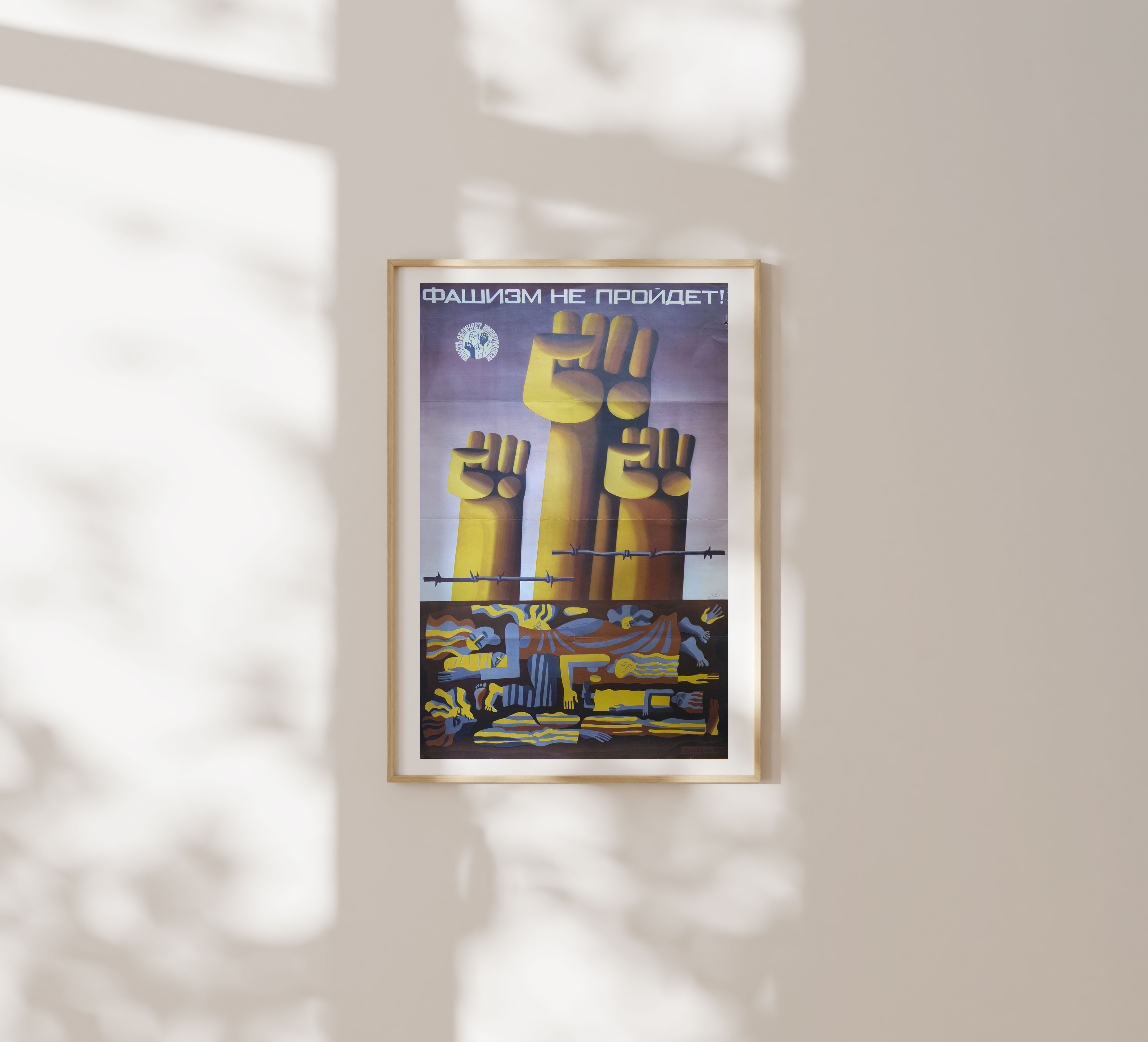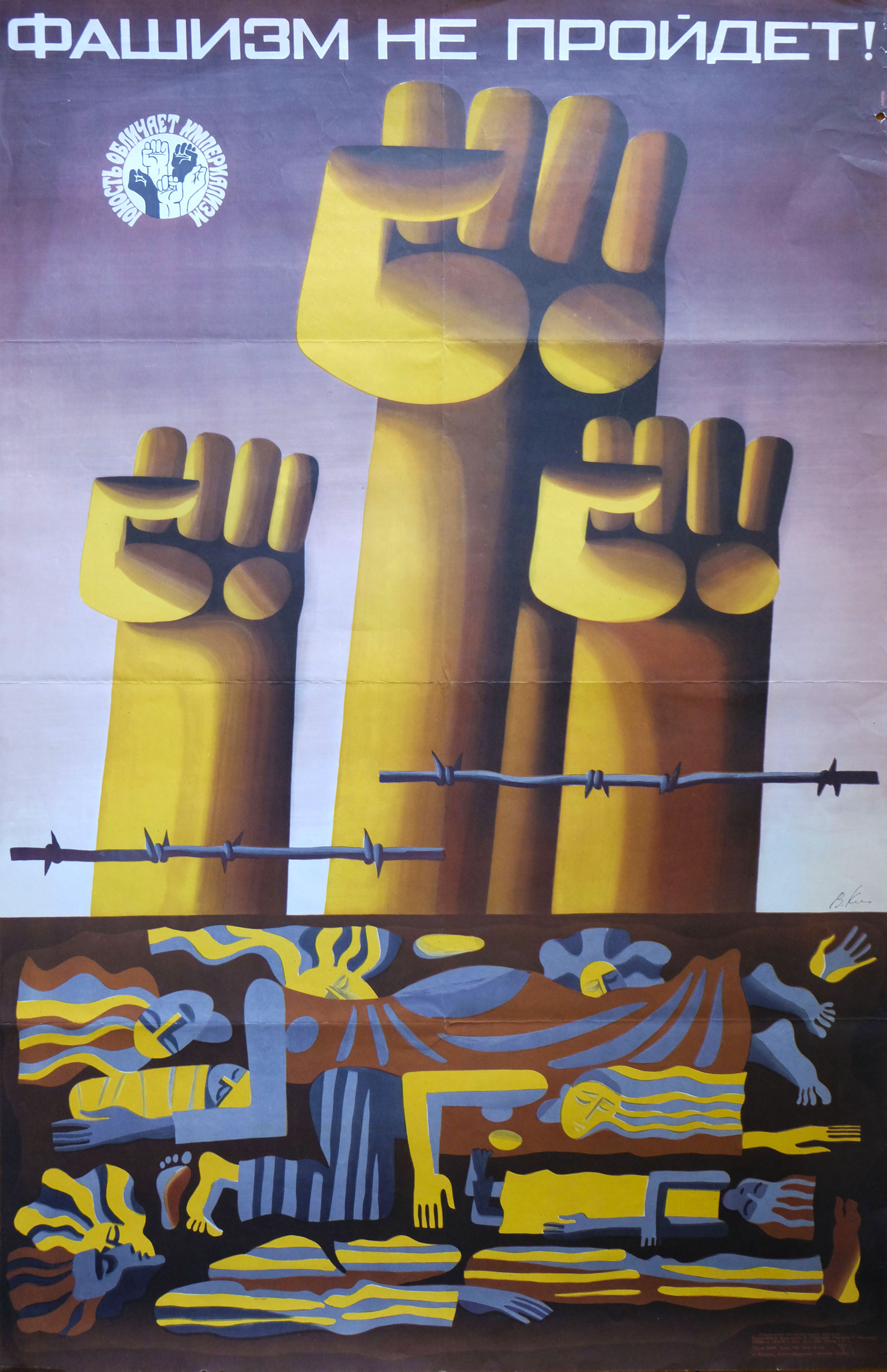
"Fascism Will Not Pass!" (1972) by Vilen Karakashev is built on a hard split: three enormous yellow fists across the top, raised in solidarity, and a band of fragmented, twisted bodies below, separated by a line of barbed wire.
The fists are simplified into sharp geometric shapes, lit so they shift from shadow into bright gold — a Constructivist treatment that gives them weight and height, almost architectural. Underneath the barbed wire, the bodies are smaller, compressed, rendered in blues and browns. The fragmentation and twisted limbs are a direct nod to Picasso's "Guernica," which is a notable move for a Soviet poster to make — pulling from Western modernism for a Soviet anti-fascist statement.
The text, "Fascism Shall Not Pass," draws on "¡No Pasarán!" from the Spanish Civil War, itself rooted in earlier French resistance slogans from WWI. The poster is stacking references on top of each other — Spain, France, Guernica — to place Soviet anti-fascism inside a broader international tradition rather than treating it as a purely domestic theme.
The barbed wire does double duty: a literal barrier in the image, and the dividing line between the two halves of the composition — resistance above, atrocity below.
Karakashev (b. 1935, Baku) trained at the Moscow State Academic Art Institute, graduating in 1962, and built a reputation through the 1960s and early 1970s for political and social posters, winning multiple "best poster of the year" awards. His work is held in the State Museum of Political History of Russia and the Russian State Library.