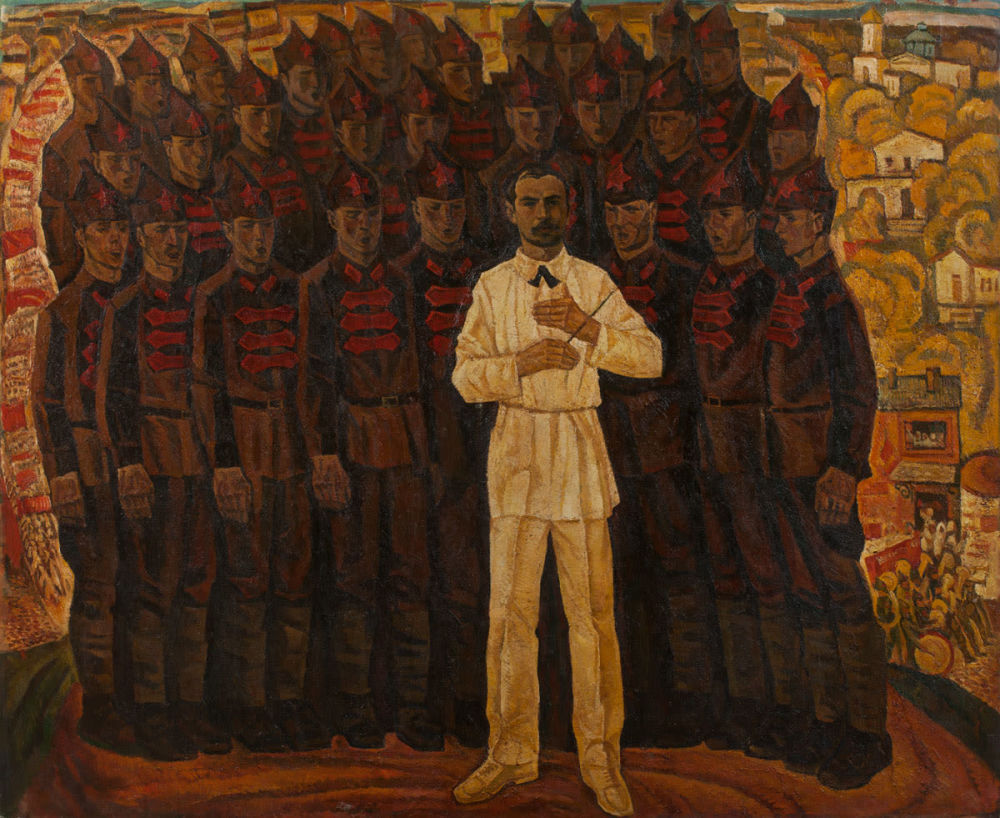
Mikhail Nikiforovich Cherny’s “Leontovich with a Choir” (1977) stands as a testament to the artist's unique ability to blend Socialist Realism with Ukrainian folk traditions, creating a work rich in cultural and historical significance. The painting offers a multifaceted portrayal of composer Mykola Leontovych, highlighting the complex socio-cultural landscape he inhabited and his role in Ukrainian national identity.
The use of colour in this piece is particularly striking. Leontovych, dressed in luminous white, stands out against the darker, earthy tones of the choir, who are depicted in Red Army uniforms. Cherny's handling of the choir, rendered in deep browns and reds, obscures their individual features, creating a sense of collective identity. This contrast between Leontovych and the choir amplifies his individual presence, reinforcing his role as a cultural leader. The village details in the background, painted in a muted style, serve as a subtle nod to the rural Ukrainian influences that shaped Leontovych's music.
The composition underscores the tension between personal creative expression and the collective identity promoted by Soviet ideology —a tension further intensified by Leontovych's legacy. His liturgy, the first to be composed in the Ukrainian language, also made him a target. The father of Ukrainian choral music, whose folk-inspired compositions helped define the Ukrainian national identity, was tragically murdered by a Soviet agent in 1921. This adds a layer of poignancy, reflecting the dangerous intersection of art and politics in Soviet Ukraine.
Mikhail Nikiforovich Cherny, born in 1933 in Vinnytsia, is celebrated for his distinctive blend of Socialist Realism and Ukrainian folk traditions, known as the Ukrainian Neo-Folk Style. A graduate of the Odessa Art School and Kiev State Art Institute, Cherny’s works often feature academic romanticism and historicism, setting him apart during the Soviet period of censorship. His work has been honored with prestigious awards, including first prizes at the Arkhip Kuindzhi and Nikolai Trublaini contests. In 2017, his retrospective Life in Art celebrated his career, and his work is held in leading Ukrainian museums and private collections worldwide.