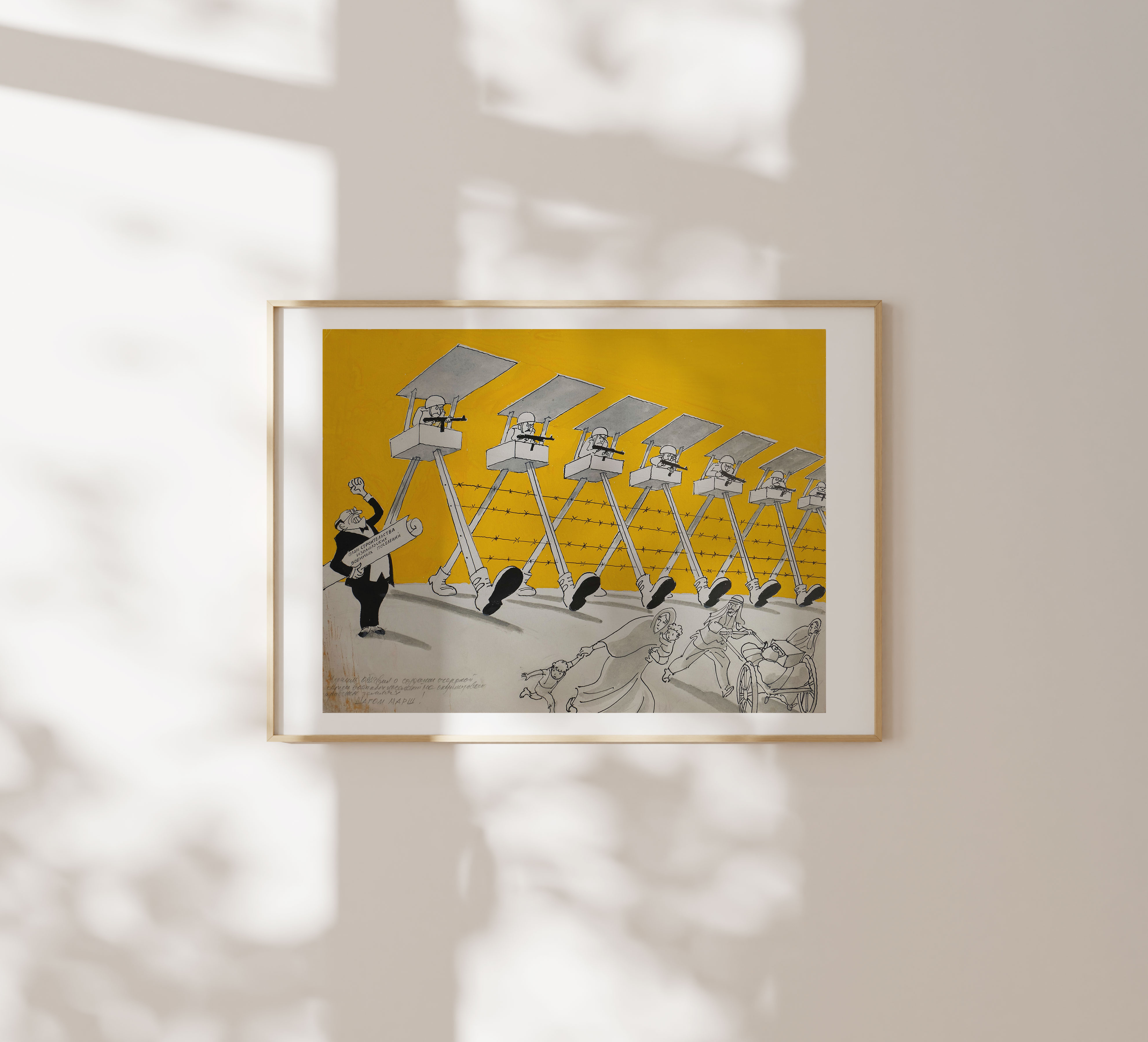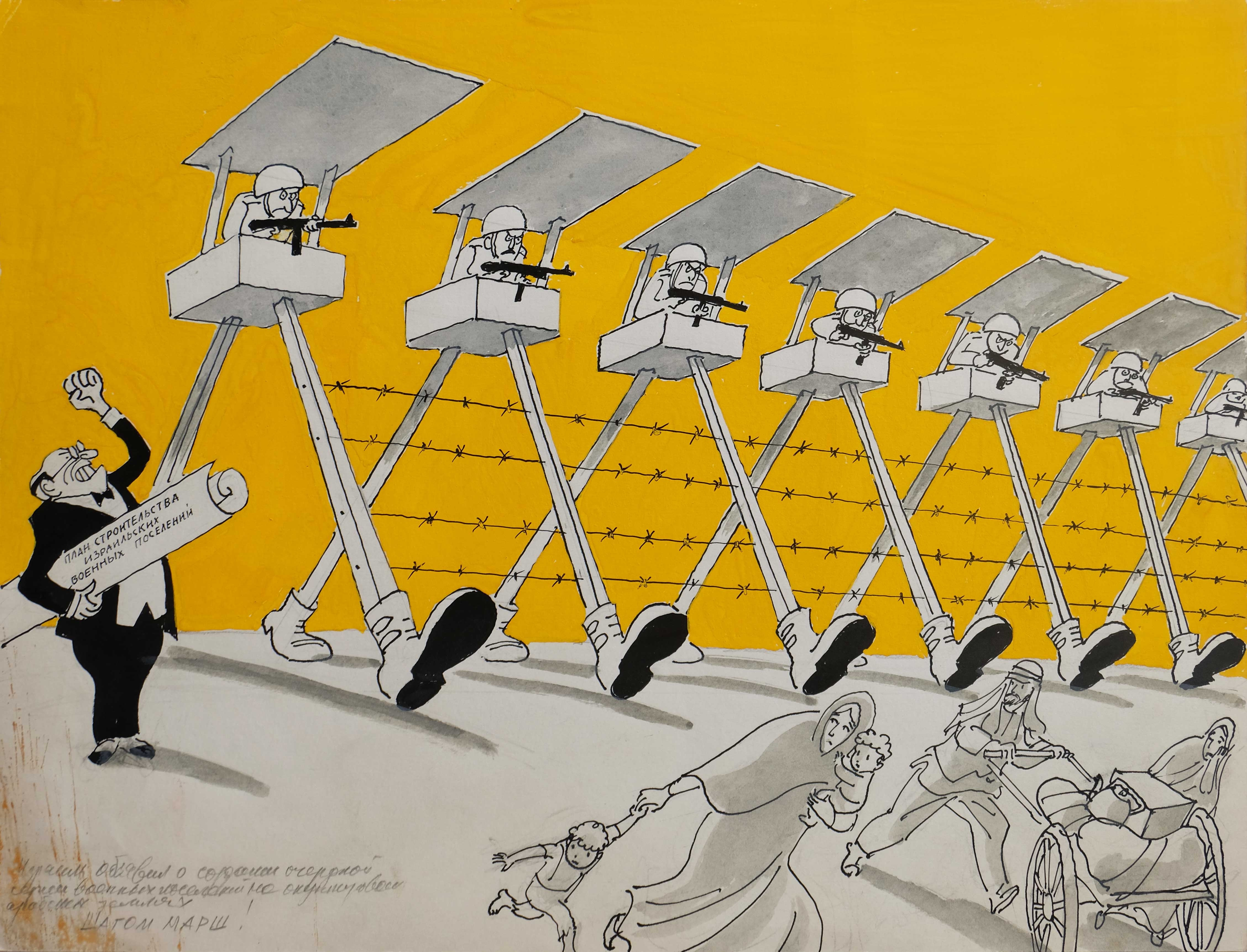
“Israeli Plan” (1979) by Yuri Andreevich Cherepanov is a sharp critique of Israeli settlement policy, created for Krokodil during a tense phase of the Cold War. Published in the wake of the 1978 Camp David Accords, the cartoon channels Soviet disapproval of military outposts in occupied territories, using striking imagery to drive its point home.
Against a yellow sky, a line of personified watchtowers strides forward. Each tower perches on a pair of marching boots, its guard poised to fire. An Israeli official in black stands to the left, brandishing a scroll labeled “Plan of Construction of Israeli Military Settlements.” Below, Palestinian civilians—women, children, an elderly man—flee in panic. Barbed wire threads the scene, sealing off territory and extinguishing hope in one unbroken line.
Cherepanov’s palette is spare—black and grey forms set against that urgent yellow. His ink lines are clean and emphatic; the watercolour washes remain flat and untextured. The watchtowers collapse architecture into aggression, their rigid, simplified shapes reflecting Cherepanov’s wartime draughtsman training and work on Moscow Metro plans. The result is instantly readable: a military machine in motion, a civilian population in retreat, a political stance beyond question.
Yuri Andreevich Cherepanov (1922–2016) trained as an architect and served as a technical draughtsman during the Great Patriotic War. A member of the Union of Artists of the USSR from 1964, he contributed regularly to Krokodil, Pravda, and Ogonyok, and his cartoons appeared across Eastern Europe and Asia.