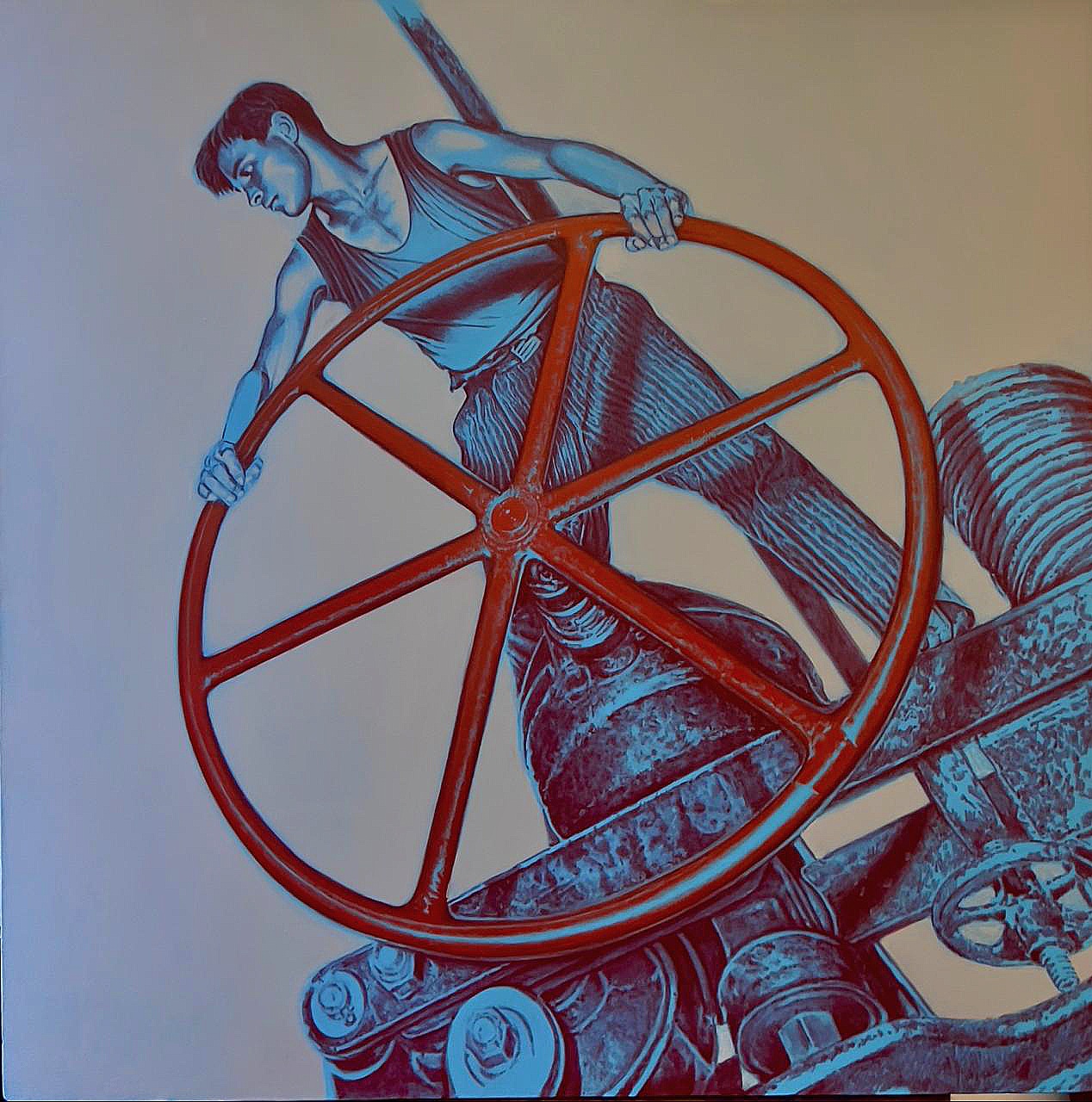
“Red Wheel” (1989) by Denis Evgenievich Egelsky is a late-Soviet painting that distills the heroic figure of the worker down to pure form—isolated, stylised, and suspended in space.
A young man grips an enormous industrial wheel, his body twisted in a dramatic diagonal across the canvas. Rendered in cool blue tones against a pale, empty background, his form is sculptural and emotionally remote. Only the wheel—painted a stark, saturated red—breaks the palette. The composition offers no setting, no signals of ideology or progress—just a lone figure and the machine.
Egelsky, a founding member of the Leningrad neo-academist movement, sought to reintroduce classical draftsmanship and idealised form into contemporary painting. His figures, often stylised and detached from narrative, resemble allegorical sculpture more than Socialist Realist archetypes. Here, the industrial setting feels almost theatrical, action suspended rather than unfolding.
In 1989, the Soviet machinery—both literal and ideological—was breaking down. Like many late-Soviet works, Red Wheel doesn’t reject the visual codes of Socialist Realism but leaves them hollowed out. The heroic worker remains, but stripped of collective struggle or clear purpose. Echoing the detached idealism of Komar and Melamid’s “nostalgic Socialist Realism,” Egelsky’s figure endures, locked in a static gesture. The wheel dominates the frame—but whether it turns, or ever did, is left unanswered.
Denis Evgenievich Egelsky (b. 1963) was born in Leningrad and became a founding figure of neo-academism in late Soviet art. Trained in classical techniques, he collaborated closely with Timur Novikov and was a professor at the New Academy of Fine Arts in St. Petersburg. His work has been exhibited in Russia, France, and Germany, and is held in the State Russian Museum, the Museum of Urban Sculpture, and the Central Exhibition Hall Manege in St. Petersburg.