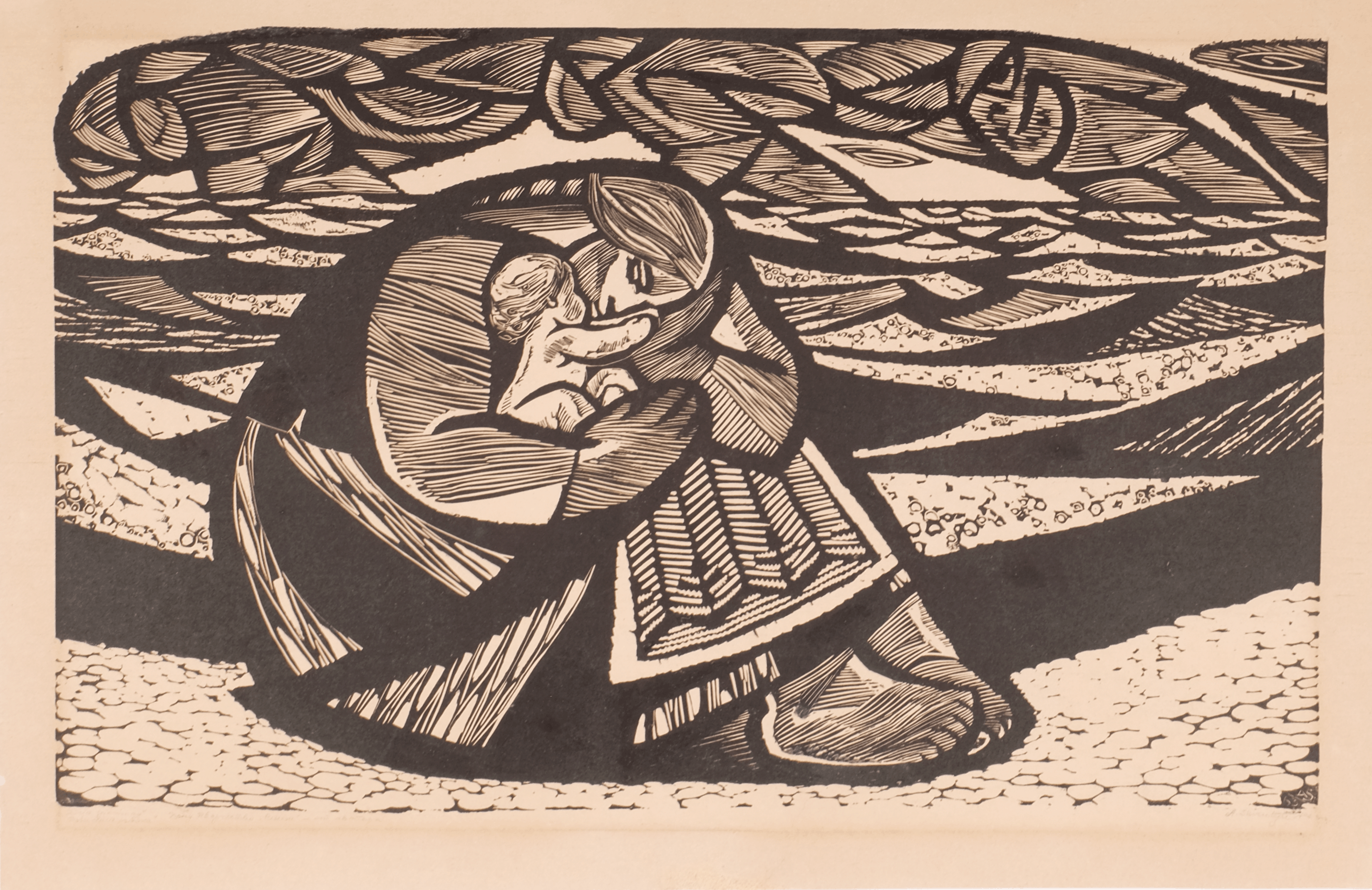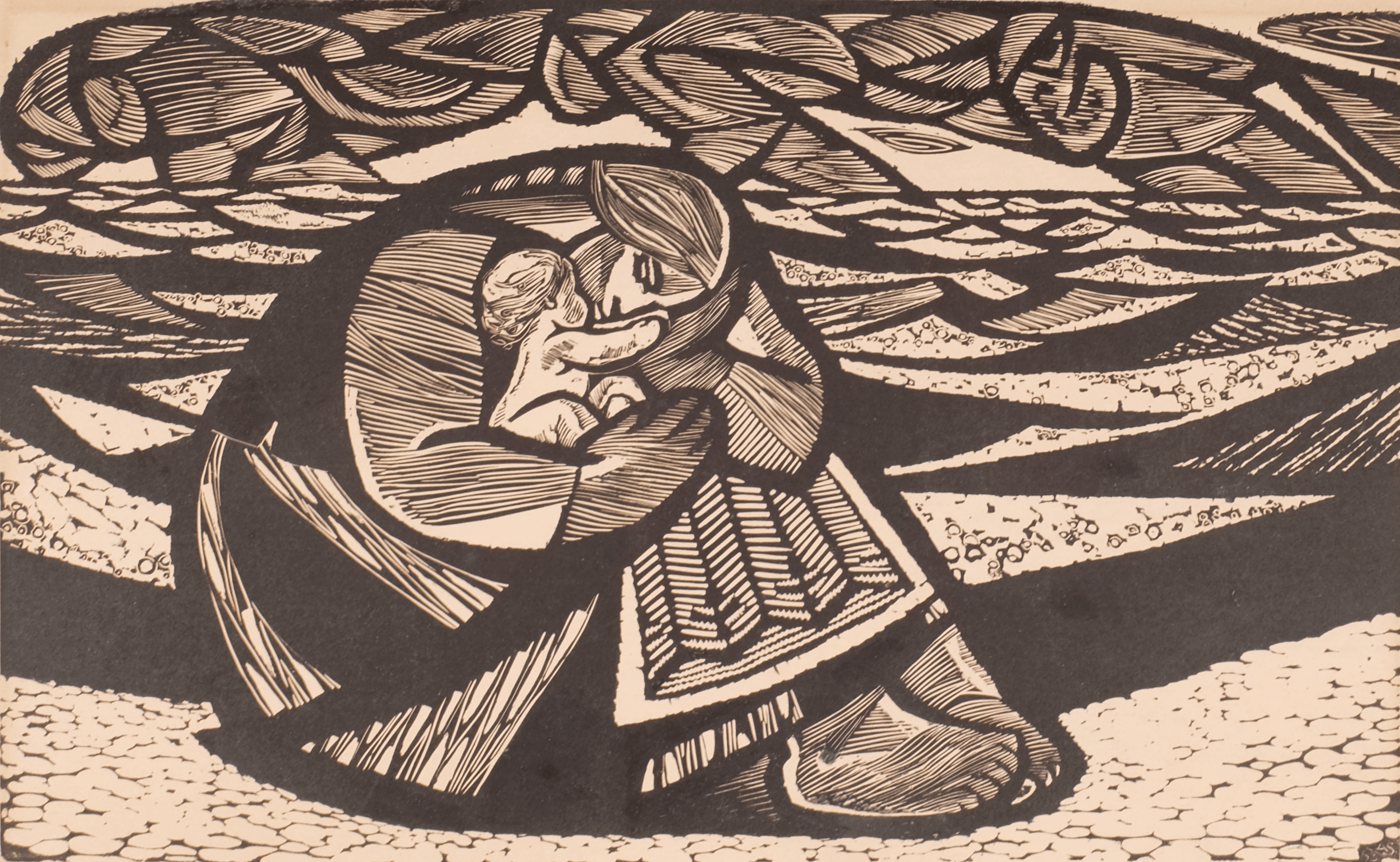
"Birth of a Fisherman" (1963) by Aldona Skirutytė reflects the importance of family, tradition, and the sea in Lithuanian coastal life. Created during a period of cultural revival in Soviet Lithuania, the linocut combines modern printmaking with motifs drawn from Lithuanian folk art.
The composition centres on a mother cradling her newborn child, their simplified forms carved in bold black and white. Behind them, stylised waves fill the background, linking the child to the sea and suggesting his future as a fisherman. The sea becomes both a source of life and a symbol of uncertainty, reflecting the close relationship between coastal communities and their environment.
Skirutytė uses the contrast of black and white to create a strong, graphic composition. Broad cuts define the figures, while finer lines give movement to the waves and texture to the clothing. Her approach reflects the influence of Expressionist printmaking while remaining rooted in Lithuanian folk traditions.
Aldona Skirutytė (1932–2005) was a Lithuanian printmaker and illustrator. She graduated from the Vilnius Art Institute in 1957 and worked as chief artist for the magazine Moteris before teaching at the institute between 1962 and 1964. She was awarded the title of Honoured Artist of the Lithuanian SSR and received the Lithuanian SSR State Prize. In 1963, she won a Gold Medal at the Second International Graphic Biennial in Florence for My Lakes . Her works are held in major museum collections, including the National M. K. Čiurlionis Art Museum, the State Tretyakov Gallery, and the National Art Museum of Belarus.