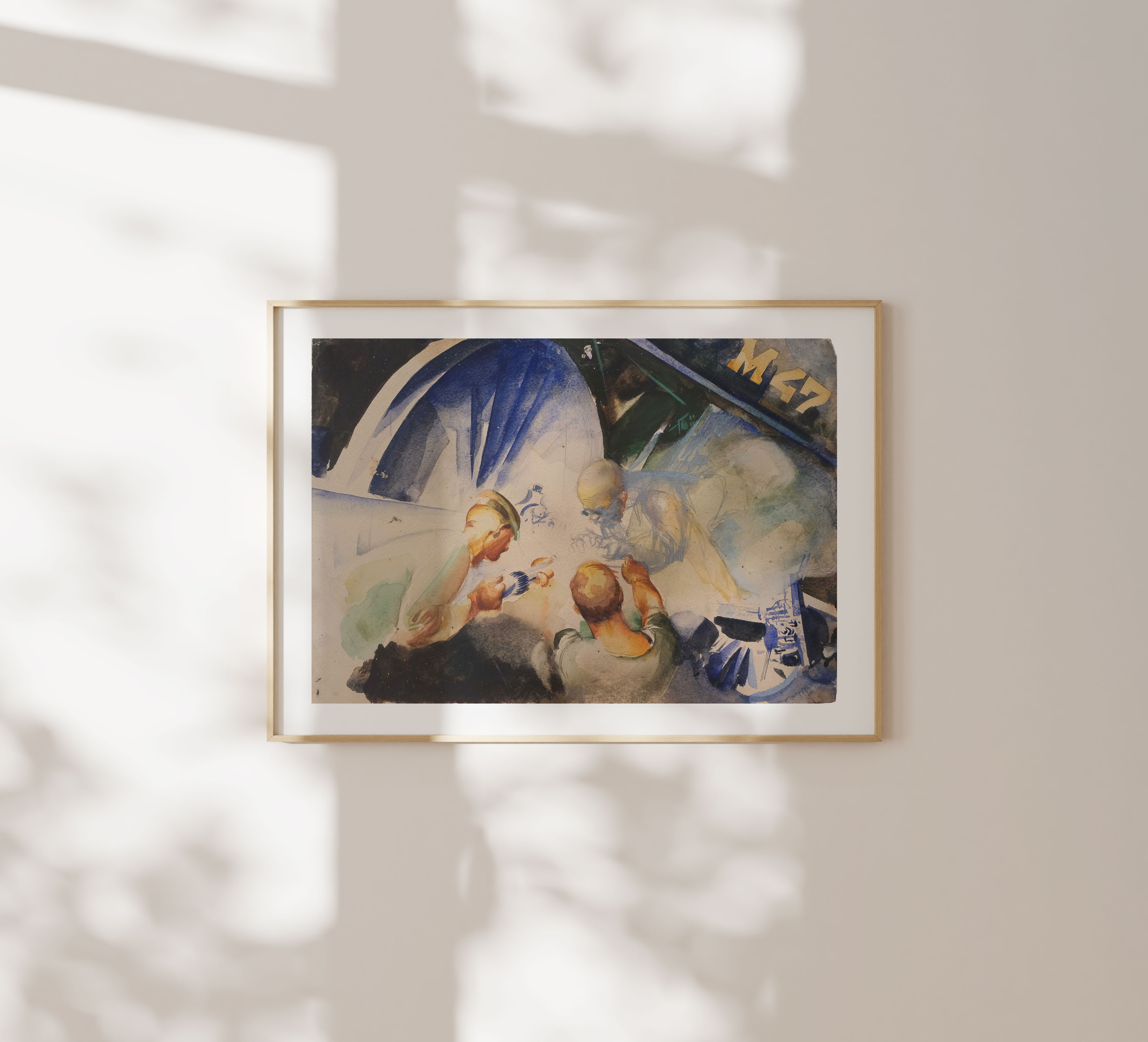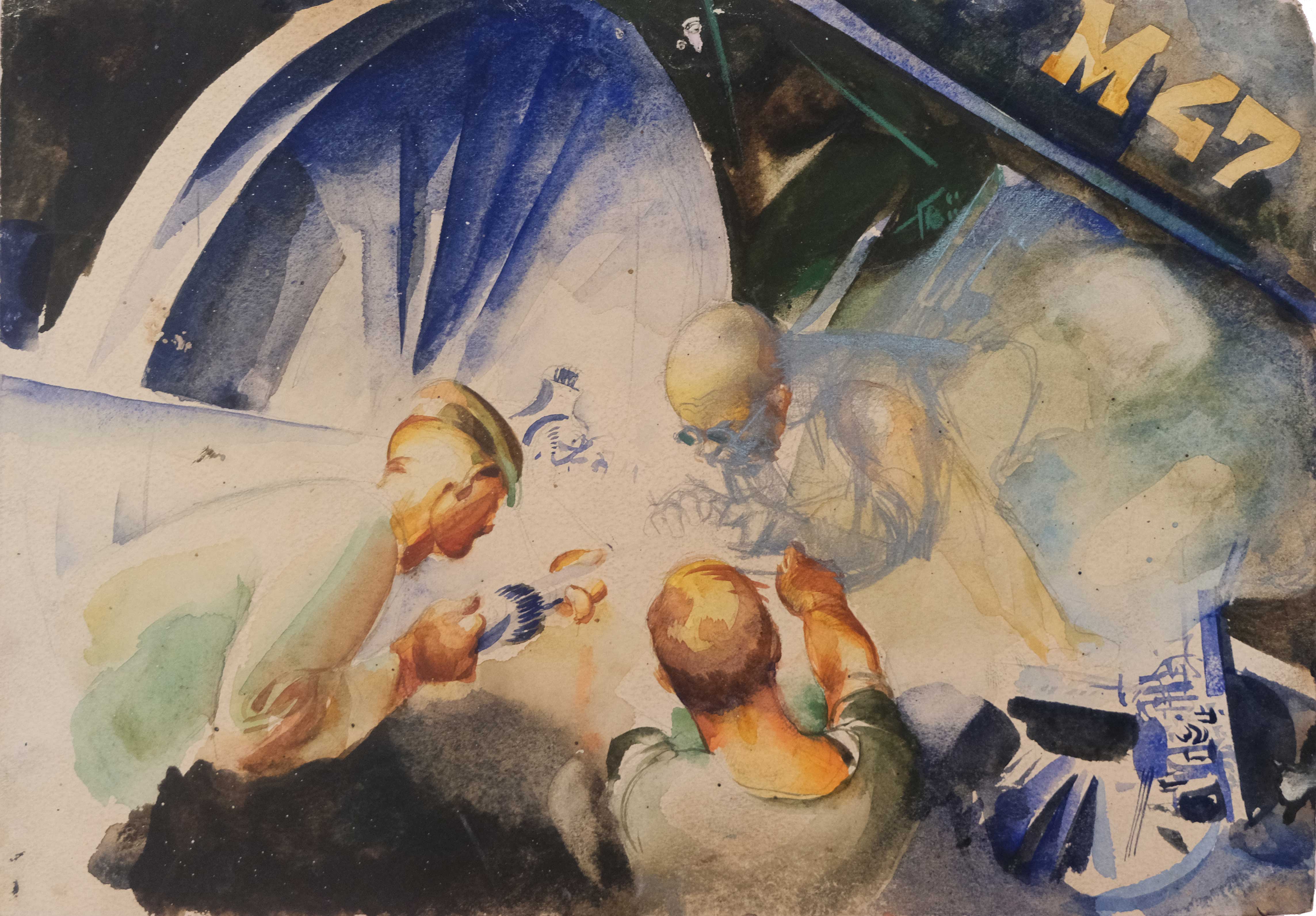
“Construction of the Moscow Metro” (1930s) by Viktor Semenovich Klimashin captures the monumental push to modernise Soviet society. Painted during the First Five-Year Plan—a period of massive infrastructural ambition—the work reflects a moment when construction sites doubled as arenas of both physical effort and ideological display.
The composition centers on three workers in the foreground, their bodies twisted in focused motion as they handle heavy industrial equipment. Klimashin employs a plunging perspective to draw the viewer into the depths of the construction pit, where architectural forms rise from abstract washes of blue and grey.
His watercolour technique is both fluid and exact: wet-on-wet blends create a sense of atmosphere, while sharp brushwork defines the machinery with precision.
What sets this painting apart is its balance between observation and idealism. The workers’ faces are individualized, yet also idealised. Their poses recall classical sculpture, while their use of modern tools reinforces the mythos of Soviet progress.
Light plays a crucial role—especially in the atmospheric blues that cast an almost otherworldly glow and elevate the scene. This tension between the real and the aspirational reflects a core tenet of 1930s Soviet art: to render labour not just visible, but noble.
Viktor Semenovich Klimashin (1912–1960) was a leading figure in Soviet graphic art during a time of sweeping cultural change. He focused on industrial and military subjects, and his work was widely exhibited throughout the 1930s and ’40s, including in the landmark "Industry of Socialism" exhibition in 1939. Today, his paintings are held in the collections of the State Tretyakov Gallery, the Central Armed Forces Museum, and the State Russian Museum.