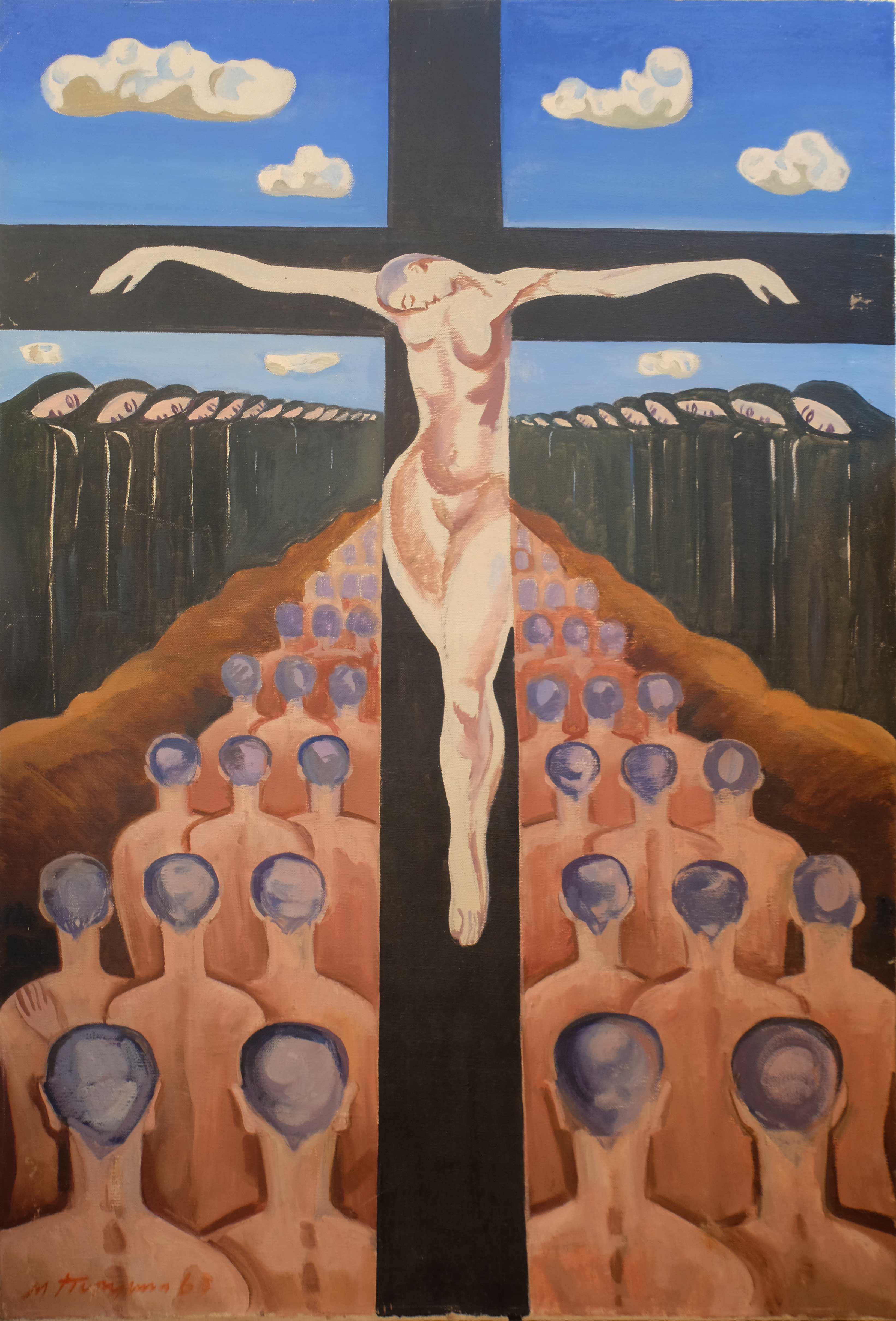
"Remember..." (1985) by Mark Nikolaevich Porunin explores systemic violence from the Soviet Great Terror, focusing on the atrocities committed in Selifontovo, Yaroslavl region, where 187 victims of political repression were executed between 3 and 6 October 1938. Porunin merges religious iconography with political critique to convey the persistence of memory and the inadequacy of language to articulate suffering under systemic state oppression.
The composition centres on a crucified female figure in muted tones, dominating the vertical axis of a black cross that divides the vibrant sky. Rows of mourners in black robes flank the scene, their bowed heads forming a rhythmic, stylised line that contrasts with the central figure's exposed vulnerability. In the foreground, stretching into the distance, are rows of anonymous victims facing away from the viewer in a dugout trench. The deliberate flattening of spatial relationships recalls the aesthetic traditions of Russian Orthodox iconography. The juxtaposition of vibrant blue skies and serene clouds, divided by the crucifix, creates a tension between the transcendent nature of sacrifice and the grounded reality of earthly suffering.
The trench of faceless figures directly references the mass graves of Selifontovo, grounding the painting in the historical realities of the Great Terror. For Porunin, who was born in the Yaroslavl region, this tragedy is deeply personal. Between 3 and 6 October 1938, 187 individuals were condemned to death by the Military Collegium of the USSR Supreme Court and buried in a common grave. This event is memorialised by a monument erected in 1991, bearing the inscription: "May we never forget the victims of political repression, shot on 3-6 October 1938." By merging sacred and secular imagery, Porunin bridges historical events with universal themes of loss and remembrance. The feminisation of Christ as the crucified figure expands the symbol of sacrifice beyond religious confines to represent collective human suffering. The mourners lined up along the trench evoke both grief and complicity, emphasising the collective responsibility and silence surrounding systemic violence.
Mark Nikolaevich Porunin (1933–2014) was born into an artistic family. His father, a teacher and amateur artist, strongly influenced his moral creative development. He trained at the Repin Institute of Painting, Sculpture and Architecture in Leningrad. In 1961, Porunin moved to Kazakhstan where he helped establish the Union of Artists of Kazakhstan's Tselinograd branch. Despite facing political criticism and censorship during the Soviet era, including a banned exhibition in 1983, he later received recognition as an Honored Artist of the Kazakh SSR in 1989. Porunin's works are held in the collections of major museums in Astana, Almaty, and Pavlodar.