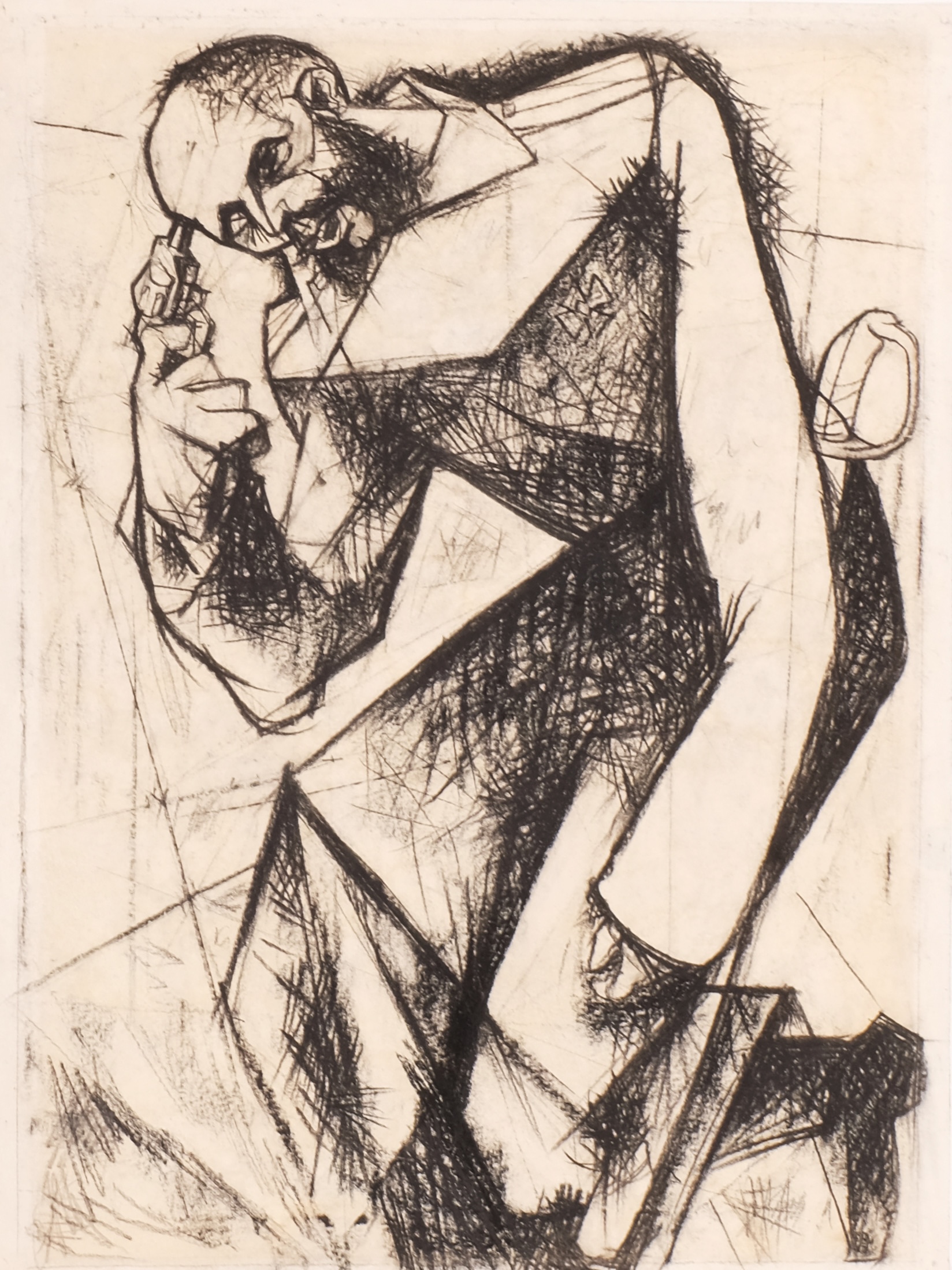
"February Revolution" (1970) by Mikhail Zakharievich Rudakov depicts a soldier in a moment of despair during the February Revolution of 1917. The work reflects the uncertainty faced by many soldiers as the Russian Empire collapsed and loyalties shifted between the Tsarist regime and the emerging revolutionary government.
The composition centres on the soldier holding a pistol to his head. His figure is broken into angular, Cubist-inspired forms, while the ceremonial sword at his belt contrasts with the modern firearm turned against himself. Together, they symbolise the conflict between the old order and the new. The fragmented composition reinforces the soldier's psychological turmoil and the wider upheaval of the revolution.
Executed in charcoal, the drawing relies on bold strokes, dense cross-hatching, and strong contrasts between light and dark to create a sense of tension and immediacy. The raw handling of the medium strips away any romantic view of war or revolution, focusing instead on the personal cost of political change.
Mikhail Zakharievich Rudakov (1914–1985) was a Soviet painter, graphic artist, and teacher. He studied at the Kharkov Art and Industry Institute before serving in the Second World War. Captured by German forces, he later spent several years in the Vorkuta labour camp before being rehabilitated in 1957. These experiences shaped much of his work, which often explored conflict, memory, and human resilience. He was named an Honoured Artist of the RSFSR in 1982, and his works are held in major collections including the State Tretyakov Gallery and the Russian Museum.